
_(19972776411).jpg)
The Moscow Metro is two things at once. It is the fastest way to get around Moscow, with trains every couple of minutes at rush hour. And it is one of the largest art collections in Russia that you can visit for a transport fare — marble halls, chandeliers, mosaics and bronze statues, some of them 90 years old.
This guide covers both. The first half explains how to use it. The second half tells you where to look.
Updated: 6 October 2026. Fares and services change. The English tariff page can lag behind the Russian version; check the official fare information and the station ticket office before you travel. Exact fare amounts are omitted here where current prices could not be independently confirmed.
The metro in numbers
- Opened: 15 May 1935, first line of 13 stations (TASS).
- Size: hundreds of stations across a growing network. Counts differ depending on whether the MCC and other rail services are included; see Mosmetro for the current network.
- Hours: stations open at 5:30 and close for entry at 1:00 (Mosmetro).
- Big Circle Line (line 11): 70 km, the longest metro ring line in the world, fully opened in 2023 (Moscow Construction Complex).
Part 1. How to use it
Step 1. Get a Troika card
The Troika is a blue plastic card for the metro, buses, trams, the MCC ring railway and the MCD commuter lines. It is a straightforward option for a visitor.
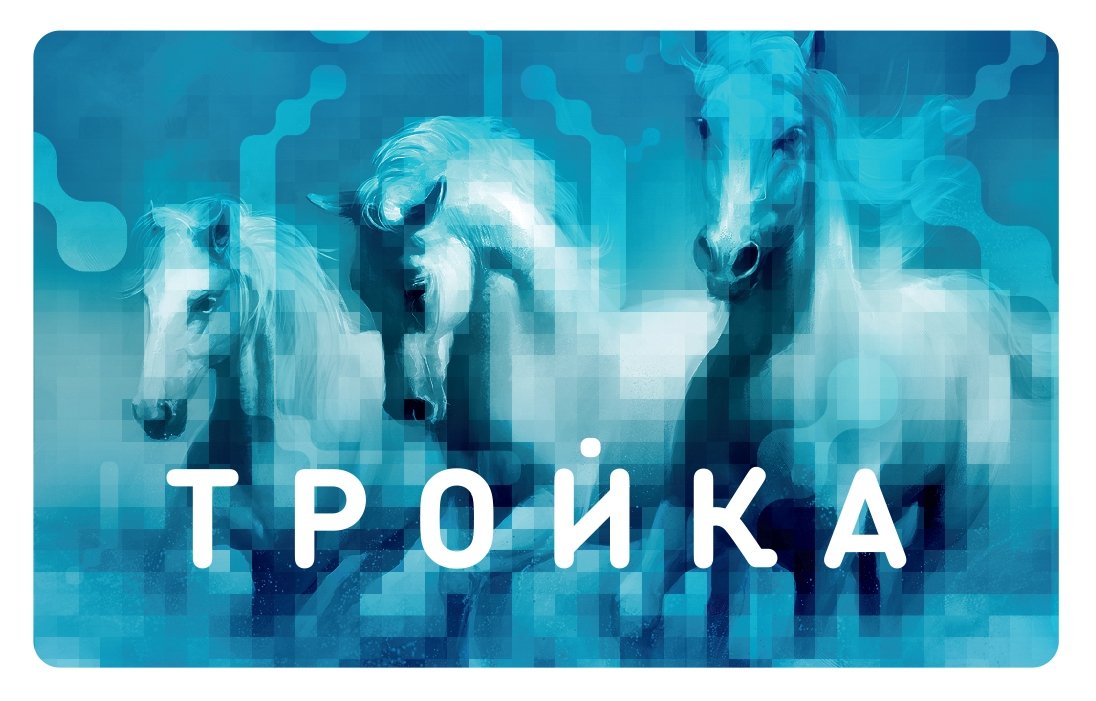 Troika card. Image: troika.mos.ru, Wikimedia Commons, CC BY 4.0

- Where to buy: the ticket office (касса) or ticket machine at any metro station.
- Deposit: the official Moscow Transport fare page lists a refundable 150 ₽ deposit. Confirm the conditions for returning the card at the ticket office.
- How to top up: at ticket machines (cash works), ticket offices, or online.
Important for foreigners: Visa and Mastercard issued outside Russia do not work on the Russian payment network; Apple Pay and Google Pay are not a reliable way to pay at Moscow metro gates. Bring cash in roubles for your first top-up. More on this in our guide to paying in Russia without Apple Pay.
Step 2. Choose a fare
There are several ticket products. Compare the current prices on Moscow Transport before buying.
| Option | When it makes sense |
|---|---|
| Troika “Wallet” balance | Occasional rides; top up and pay as you go |
| 90-minute tariff | Combining the metro with surface transport; check the current transfer conditions |
| Single-ride ticket | A one-off journey without buying a card |
| 1-day or 3-day unlimited pass | A busy sightseeing schedule; compare the pass price with your expected rides |
Participating Russian bank cards can also be used at marked gates. Biometric payment requires advance registration and an eligible linked payment method; it is not necessary for sightseeing. Foreign-issued Visa and Mastercard are not a substitute for a Troika.
Rule of thumb: count the journeys you actually plan to make. A station tour inside the paid area is usually one entry, not a separate fare at every station, so an unlimited pass is not automatically better value.
Step 3. Through the turnstile
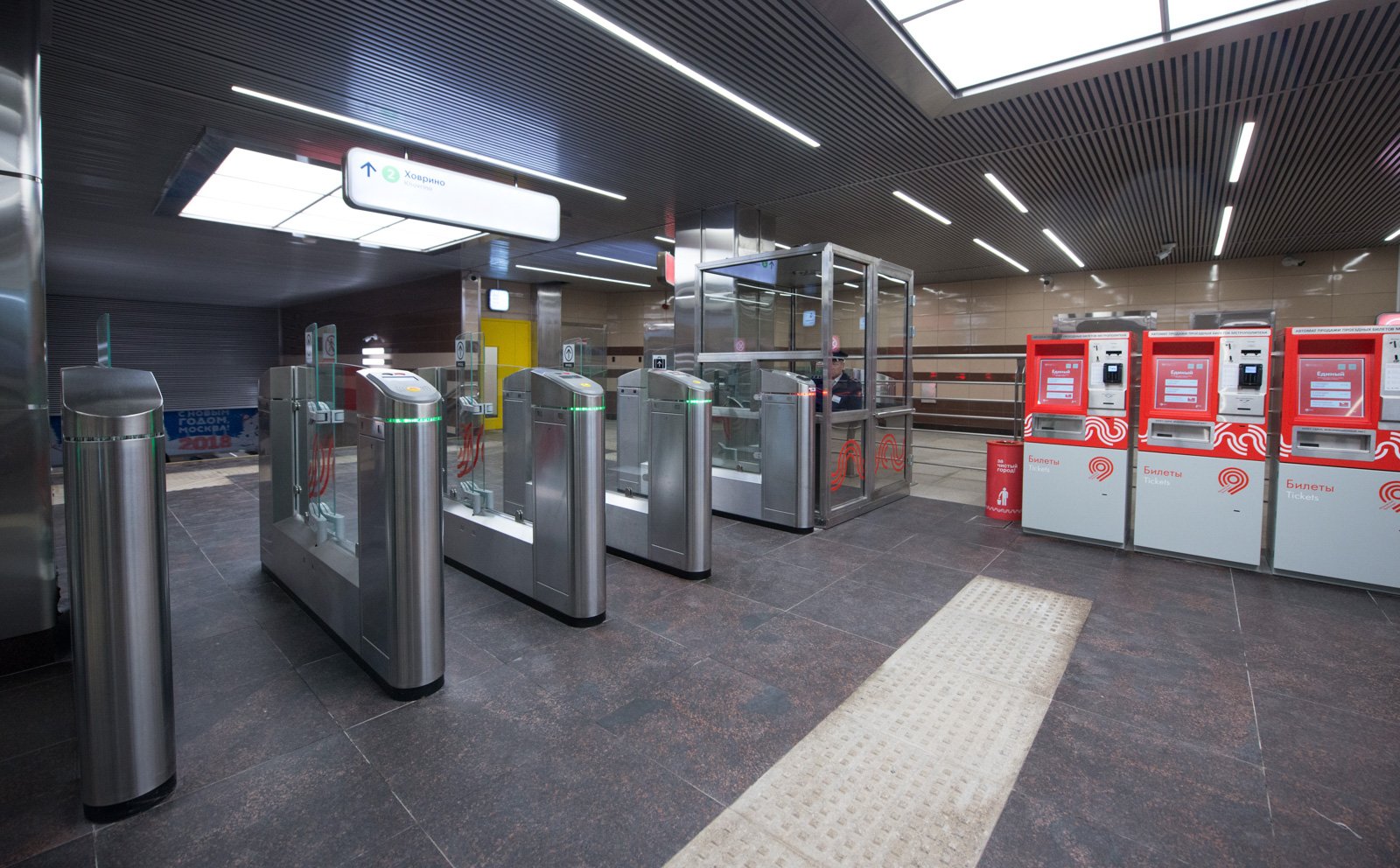 Turnstiles and ticket machines, Khovrino station. Photo: Moscow Government press service, Wikimedia Commons, CC BY 4.0
,_entrance_turnstiles.jpg)
Touch the card on the yellow circle. Wait for green. Walk through. You only pay on entry — the exit is free within the metro, and you can change metro lines without paying again as long as you stay inside the paid area. Do not apply that rule blindly to MCD commuter rail: validate your card at both entry and exit and check the fare zone. Changing between the metro and the MCC ring is also free within 90 minutes.
There may be a security frame and a bag scanner at the entrance. This is normal.
Step 4. Find your way
- Lines have a number and a colour. Line 1 is red, line 5 (the Circle Line) is brown, and so on. Follow the colour and the number, not the name.
- Signs are in Russian and English across the system. Station names are written in Latin letters too.
- Know the end station of your direction. Platform signs show the list of stations on each side.
- Exit signs: «Выход в город» means "Exit to the city". Large stations have several exits — check the signs for street names before you go up.
- Apps: download Yandex Metro or the official Moscow Metro app before arrival and save a network map. Test offline access beforehand; live disruption information needs a connection.
A local trick: on the Circle Line, a male voice announces stations on clockwise trains and a female voice on anticlockwise trains. On other lines, a male voice means you are travelling towards the centre, a female voice away from it.
Step 5. Etiquette
- Escalators: stand on the right, walk on the left. Some escalators are very long — at Park Pobedy, it takes about three minutes.
- Seats: give up your seat to elderly people, pregnant women and passengers with children. Locals do.
- Rush hours: roughly 8:00–10:00 and 17:00–19:30 on weekdays. Avoid them with luggage.
- Photos: you can take photos of the stations. Don't block the platform or the escalator. Filming is governed by separate metro rules; check permission requirements with the operator before recording video.
- Volume: the metro is quieter than you'd expect. People read, scroll or sleep. Phone calls are fine, loud conversations less so.
Step 6. Beyond the metro
- MCC (line 14) is an overground ring railway with the same fare and free transfers. Good views, fewer crowds.
- MCD (D1–D4) are commuter rail lines crossing the city. Inside the Central zone, the fare is the same as the metro.
- Airports: Vnukovo has a direct metro station on the Solntsevskaya line (8A). Sheremetyevo and Domodedovo require an additional airport connection, such as Aeroexpress, with a separate ticket; check Aeroexpress for current routes and fares.
Part 2. The underground palaces
Why the metro looks like this
Moscow had plans for an underground railway from 1875, but construction only started in the 1930s, when buses and trams could no longer cope with the growing city (mos.ru). The metro became one of the main prestige projects of Stalin's era (Reuters).
The idea was simple and political: ordinary workers should travel through palaces. So architects used marble from the Urals and the Caucasus, artists made mosaics and stained glass, and sculptors cast bronze figures. The stations told a story — about labour, victory, friendship between Soviet peoples and a bright future.
During the Second World War, the metro was also a bomb shelter. Deep stations housed thousands of people during air raids, and new stations were opened even during the war.
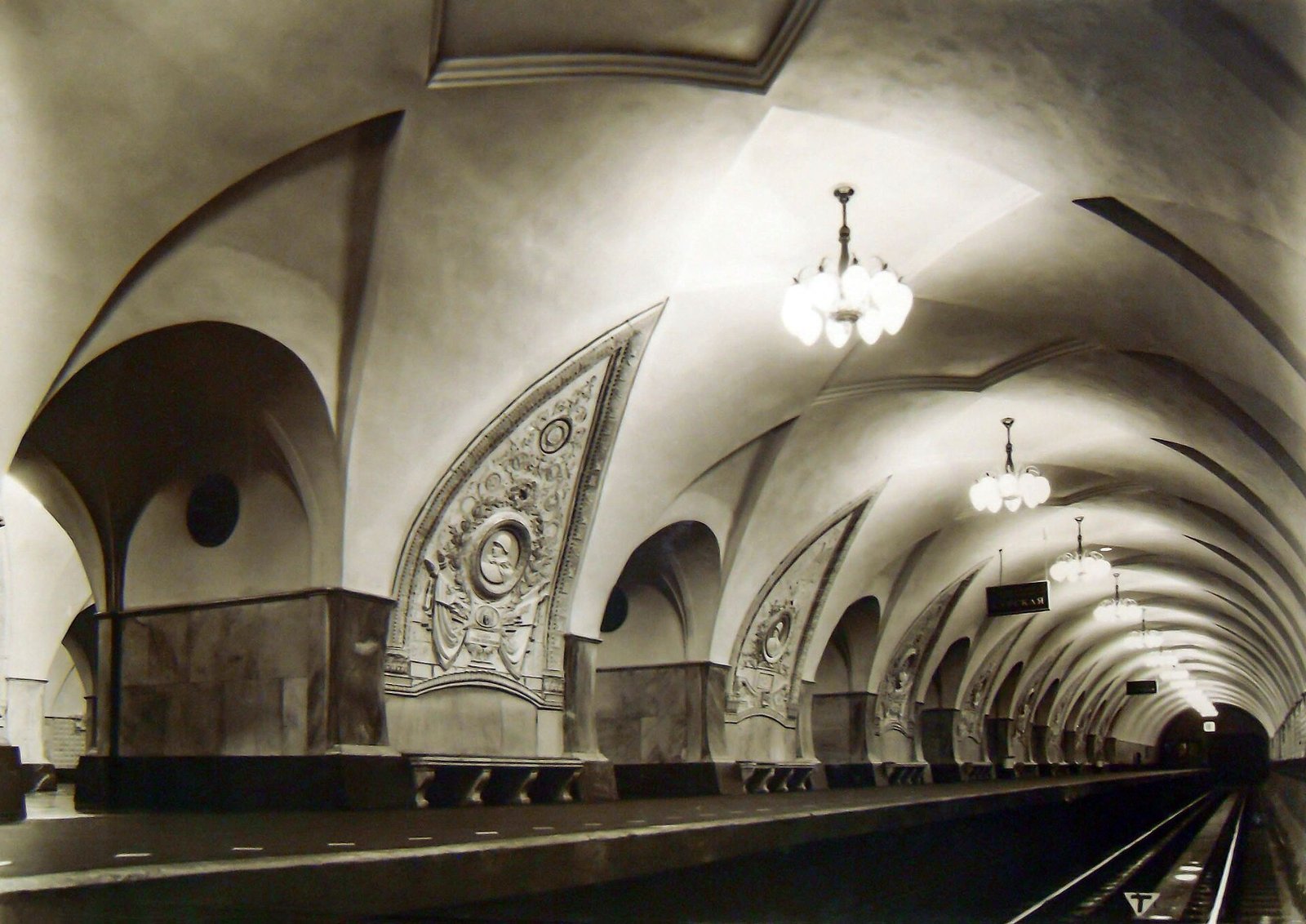 Taganskaya (Circle Line), 1949. Photo: Moscow Main Archive (Главархив Москвы), Wikimedia Commons, CC BY 4.0

After Stalin's death, the style changed. From the late 1950s, stations became plain and functional. Since the 2010s, Moscow has been building again at a huge pace, and many new stations are once again designed as architecture, not just transport.
Ten stations worth getting off for
Several are central; Park Pobedy and the Big Circle Line require a longer detour. Choose a shorter selection rather than rushing through all ten. You can visit them without leaving the metro paid area.
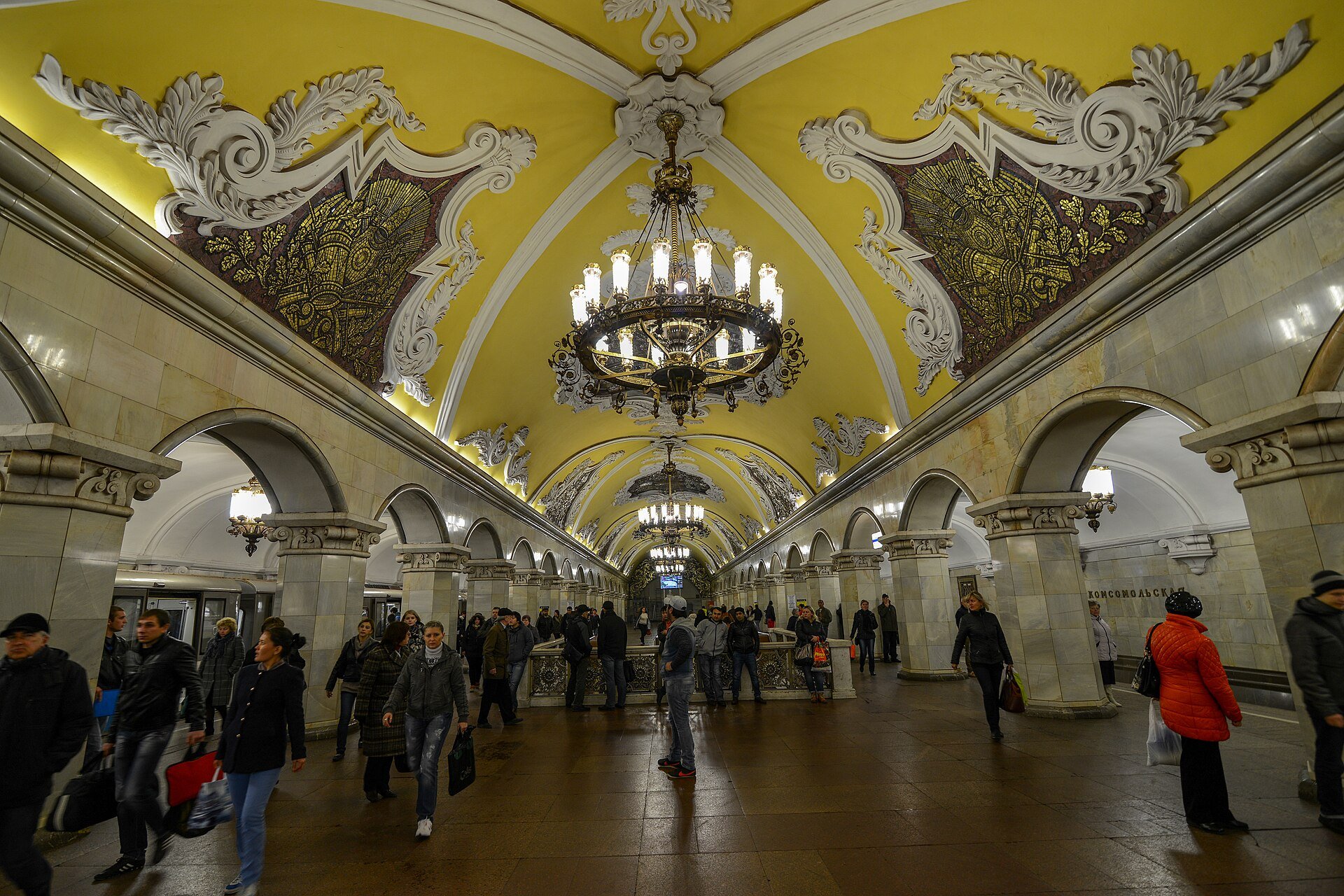
1. Komsomolskaya (Circle Line, 1952). The most palatial of all. Yellow baroque vaults, massive chandeliers and ceiling mosaics of Russian military heroes. It sits under the square with three railway stations, so it is busy — come early on a weekend. (Photo at the top.)
2. Mayakovskaya (Green Line 2, 1938). Steel and pink marble columns, and 34 ceiling mosaics by Alexander Deineka on the theme of "a day of the Soviet sky" — look up. The station won a Grand Prix at the 1939 New York World's Fair. In November 1941, with the Germans near Moscow, a ceremonial meeting for the anniversary of the Revolution was held here, underground.
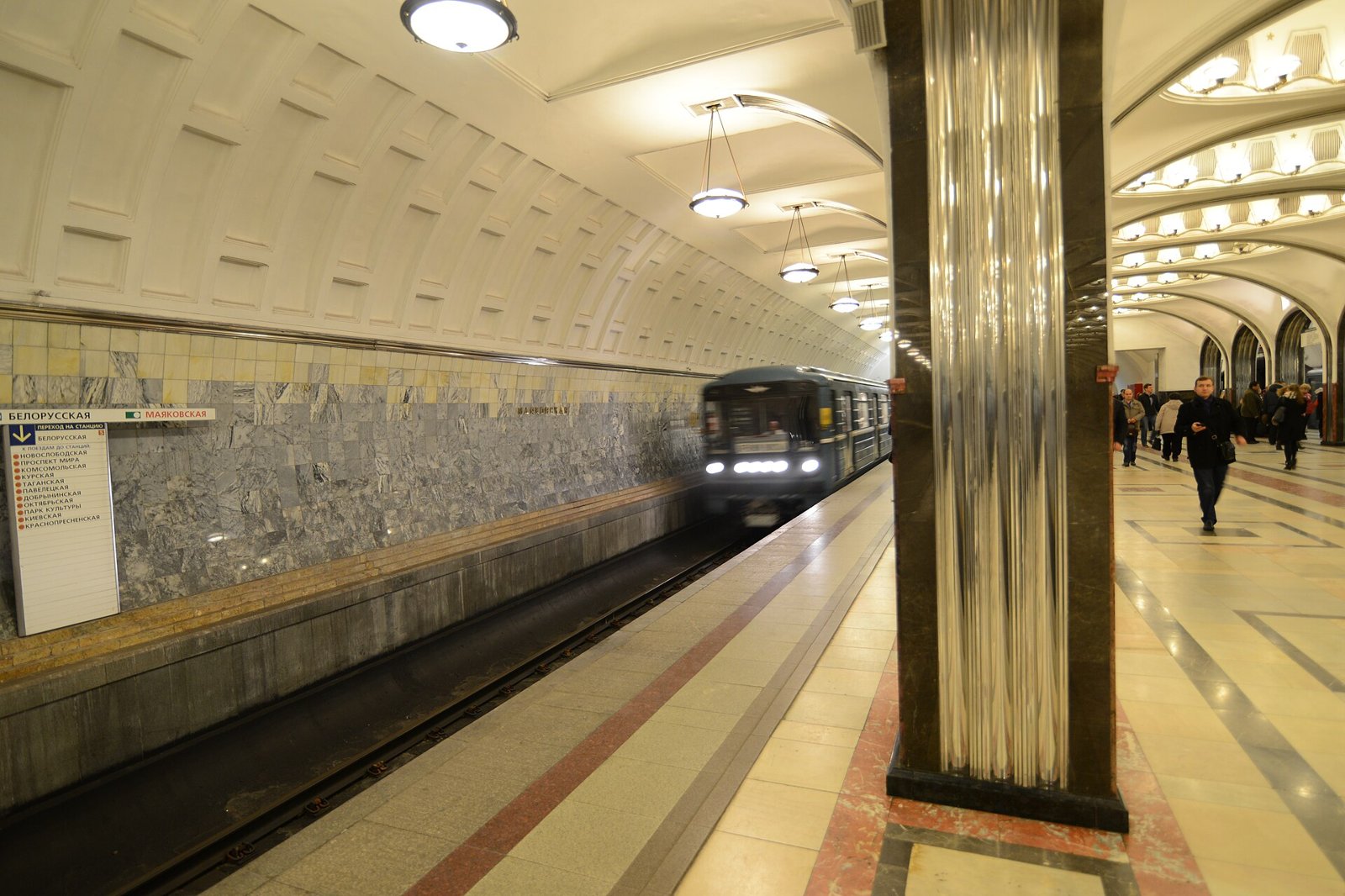 Mayakovskaya. Photo: Jorge Láscar, Wikimedia Commons, CC BY 2.0
_(19964678325).jpg)
3. Ploshchad Revolyutsii (Blue Line 3, 1938). Seventy-six bronze figures by Matvey Manizer: soldiers, workers, farmers, students, athletes. Look for the border guard with a dog — the dog's nose is polished gold by passengers who rub it for luck before exams.
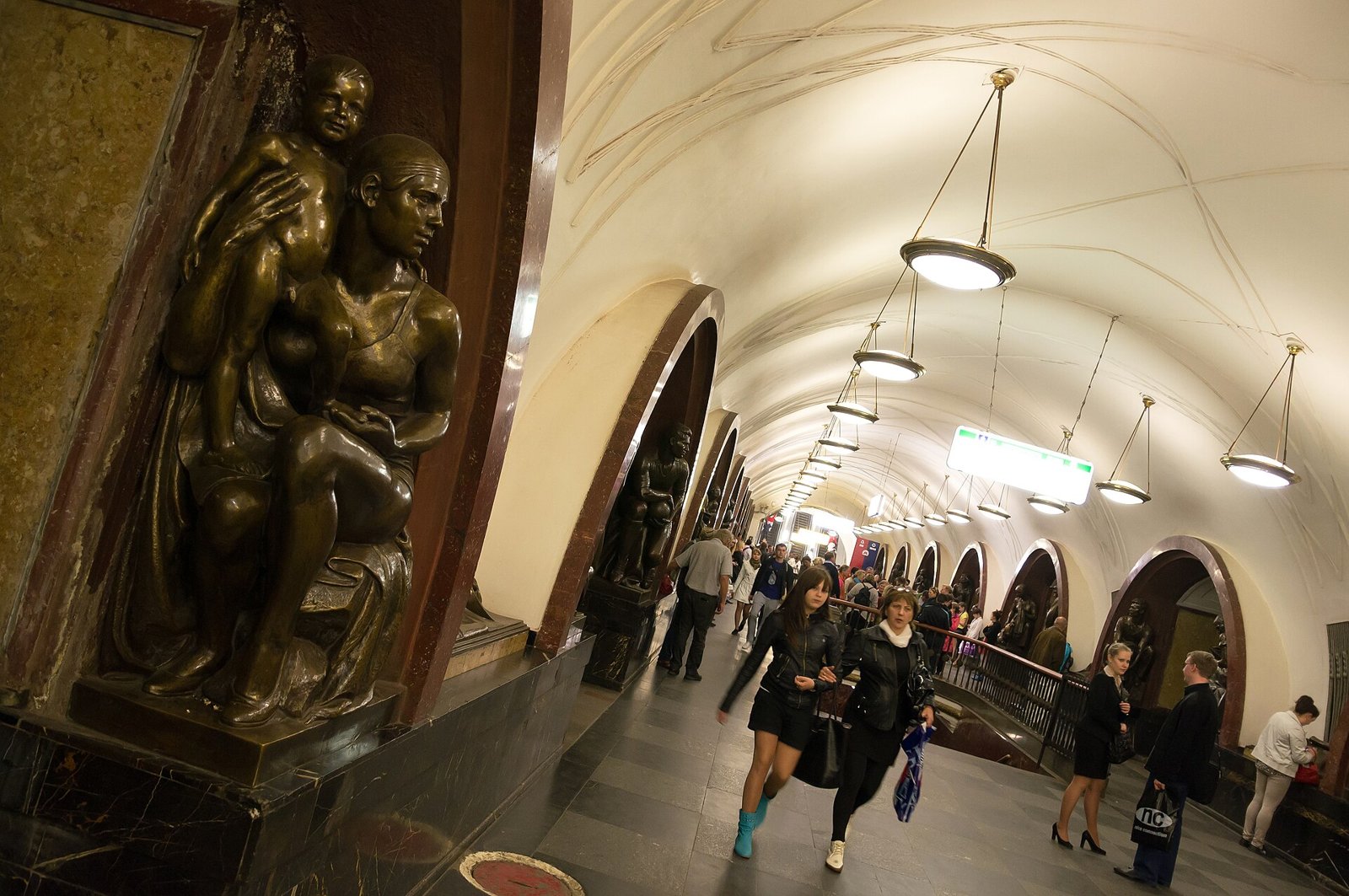 Ploshchad Revolyutsii. Photo: Vyacheslav Argenberg, Wikimedia Commons, CC BY 4.0

4. Novoslobodskaya (Circle Line, 1952). Thirty-two stained-glass panels lit from behind, made by artists from Riga, framed in brass. At the end of the hall, a mosaic by Pavel Korin called "Peace in the World". Many people call it the most beautiful station in Moscow.
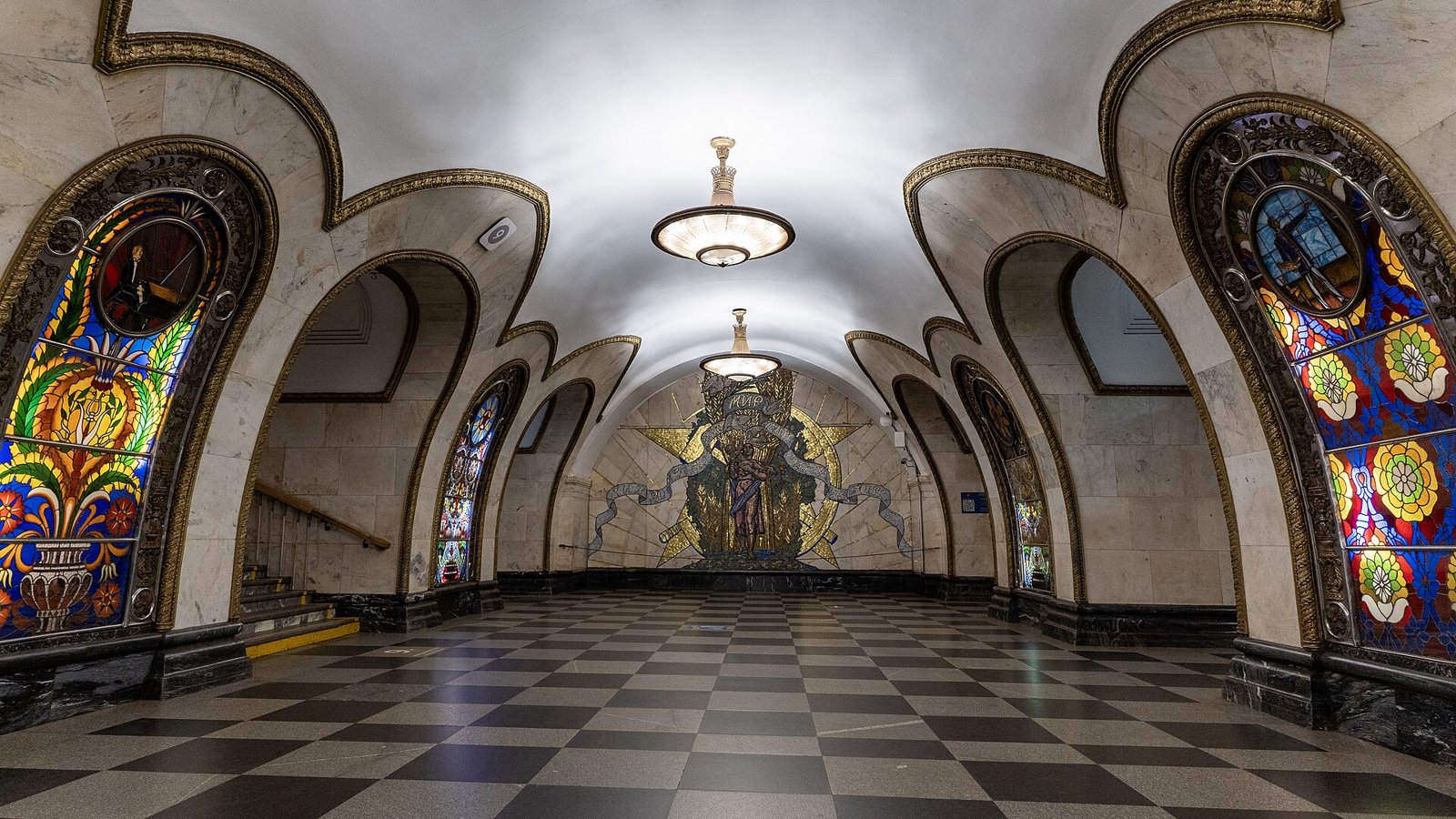 Novoslobodskaya. Photo: Kandukuru Nagarjun, Wikimedia Commons, CC BY 2.0
.jpg)
5. Kiyevskaya (Circle Line, 1954). Arched halls with mosaics on the theme of Russian–Ukrainian history and friendship, made for the 300th anniversary of the union of the two peoples. Today, it reads very differently — which makes it one of the most interesting stations to think about, not just to look at.
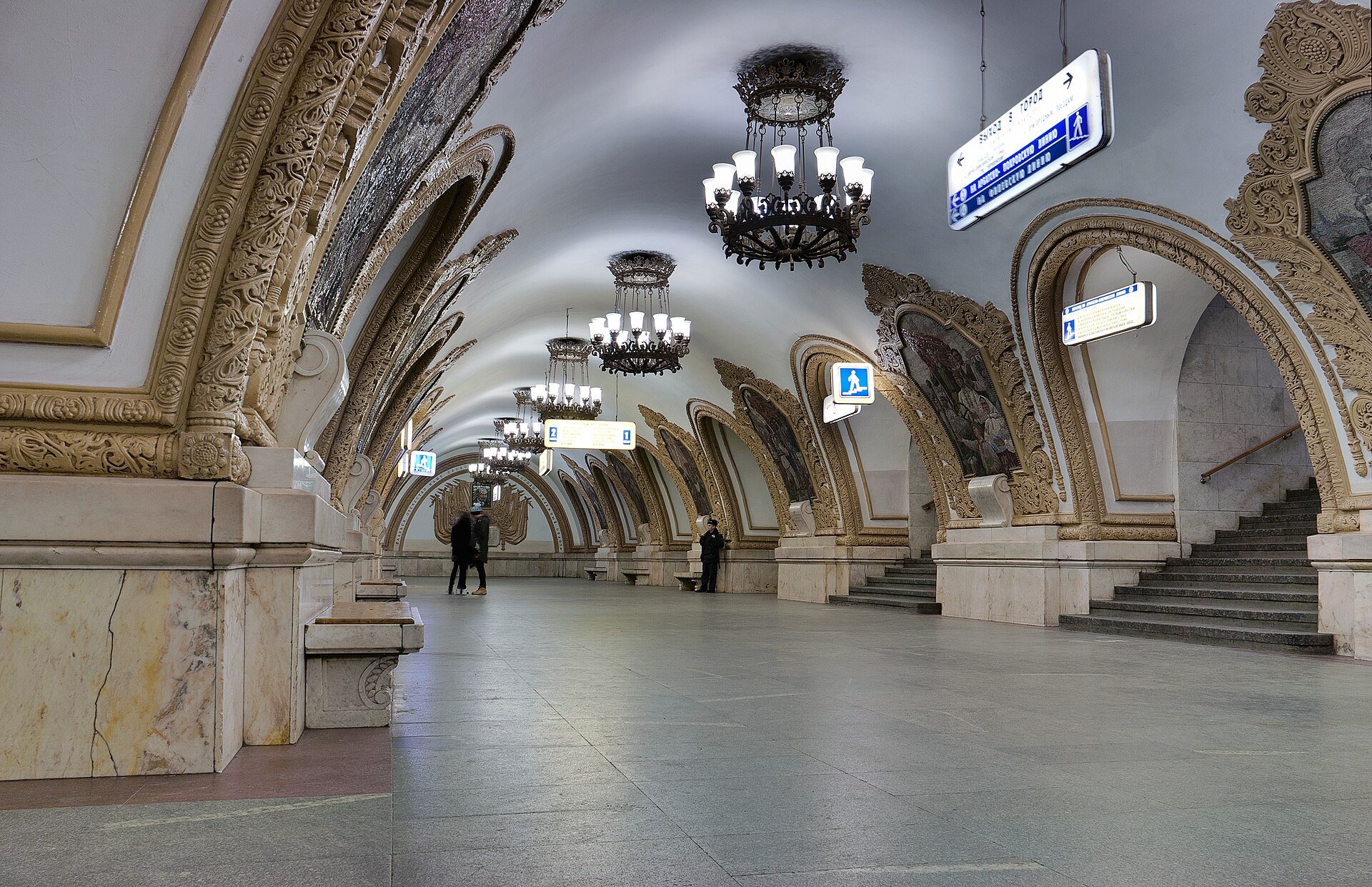 Kiyevskaya (Circle Line). Photo: Ludvig14, Wikimedia Commons, CC BY-SA 4.0

6. Elektrozavodskaya (Blue Line 3, 1944). Built during the war and named after a nearby electric lamp factory. The ceiling is covered with rows of round lamps, and the marble walls carry reliefs of people working for the front.
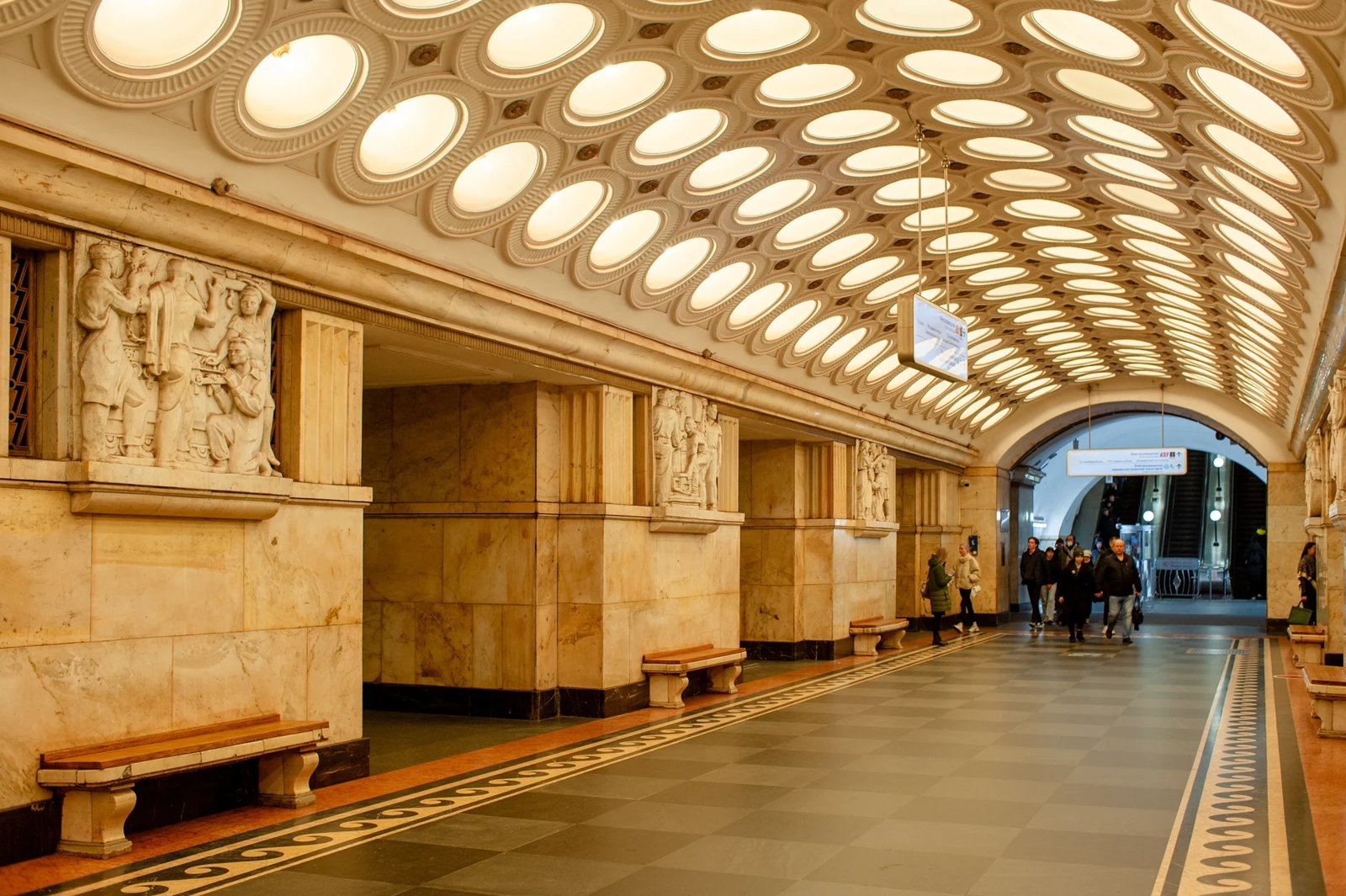 Elektrozavodskaya. Photo: Artyom Svetlov, Wikimedia Commons, CC BY-SA 4.0

7. Arbatskaya (Blue Line 3, 1953). One of the longest stations in the system. It was built very deep after the war so it could serve as a shelter. Red marble, ornate plaster and bronze chandeliers.
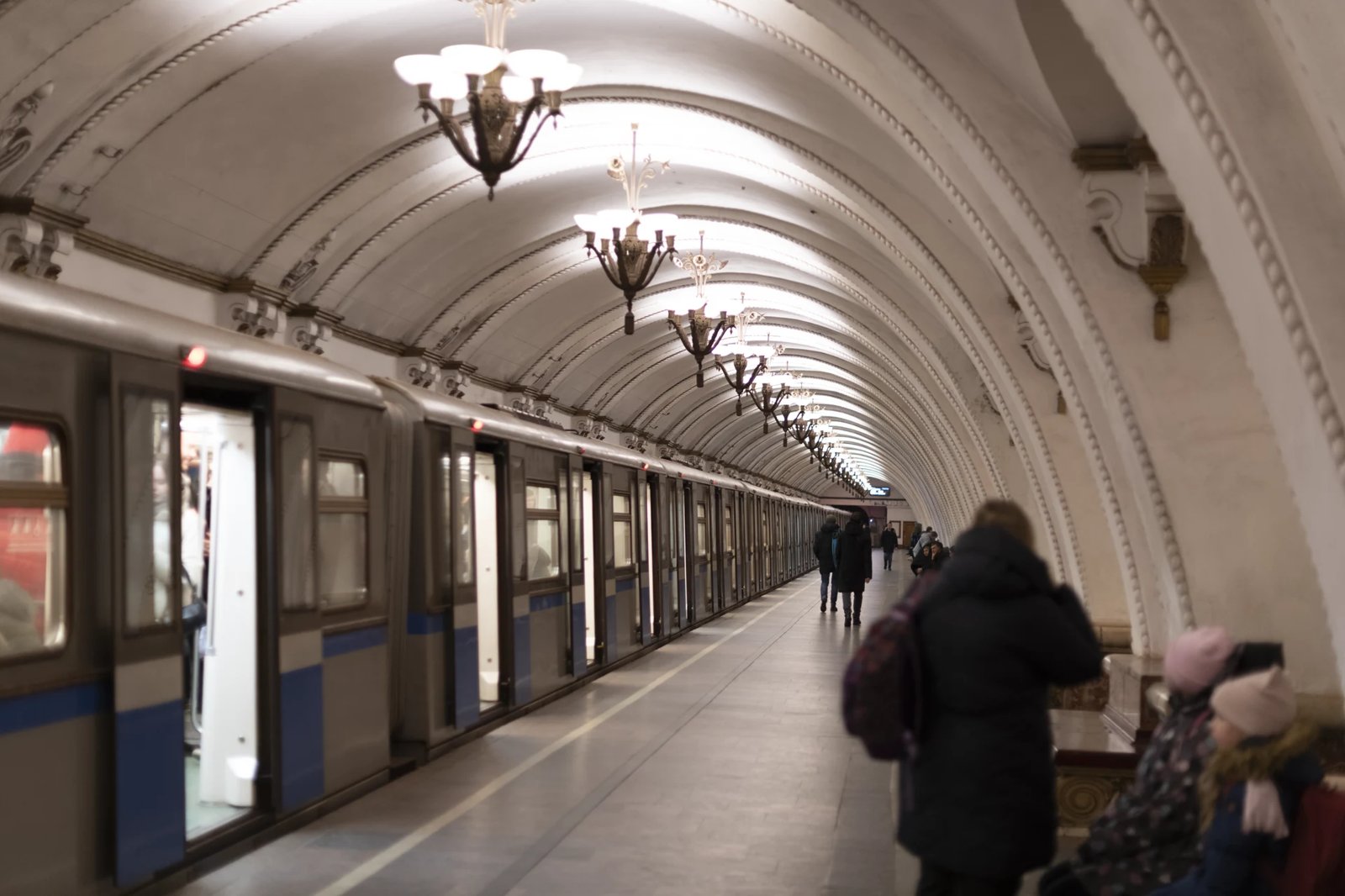 Arbatskaya. Photo: Artyom Svetlov, Wikimedia Commons, CC BY-SA 4.0

8. Taganskaya (Circle Line, 1950). White vaults with blue-and-white ceramic panels dedicated to soldiers of different branches of the army. Compare the 1949 archive photo above with what you see today.
9. Park Pobedy (Blue Line 3, 2003). Not old, but extreme: it is one of the deepest stations in the world, and its escalators are among the longest in Europe. The ride down is the attraction.
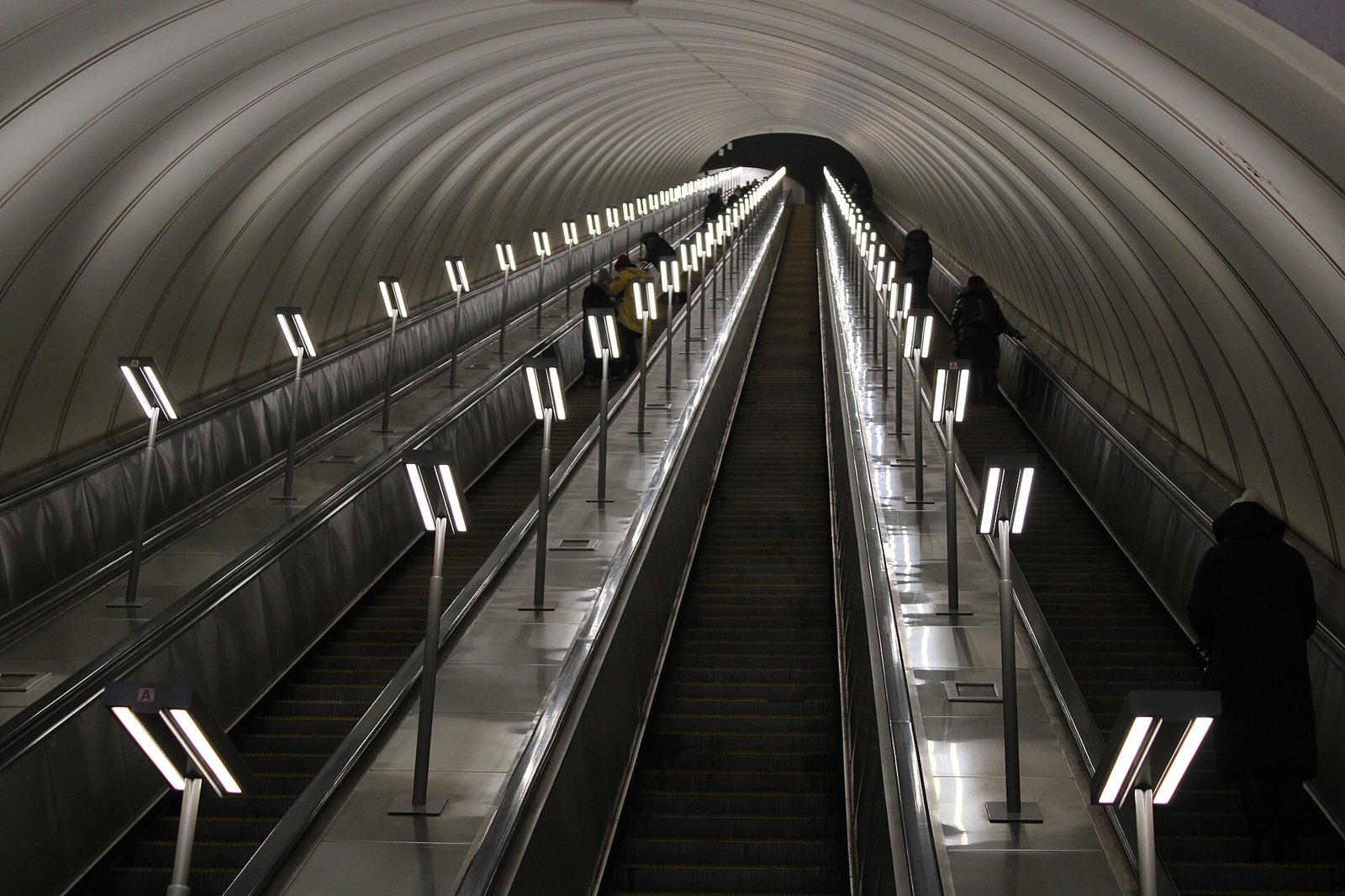 Park Pobedy. Photo: Lukdmi, Wikimedia Commons, CC BY-SA 4.0

10. The Big Circle Line (line 11, 2023). To see the new Moscow Metro, ride a few stops of the Big Circle Line. Each station has its own design theme. Sokolniki, for example, uses retro typography and posters to tell the history of the metro itself.
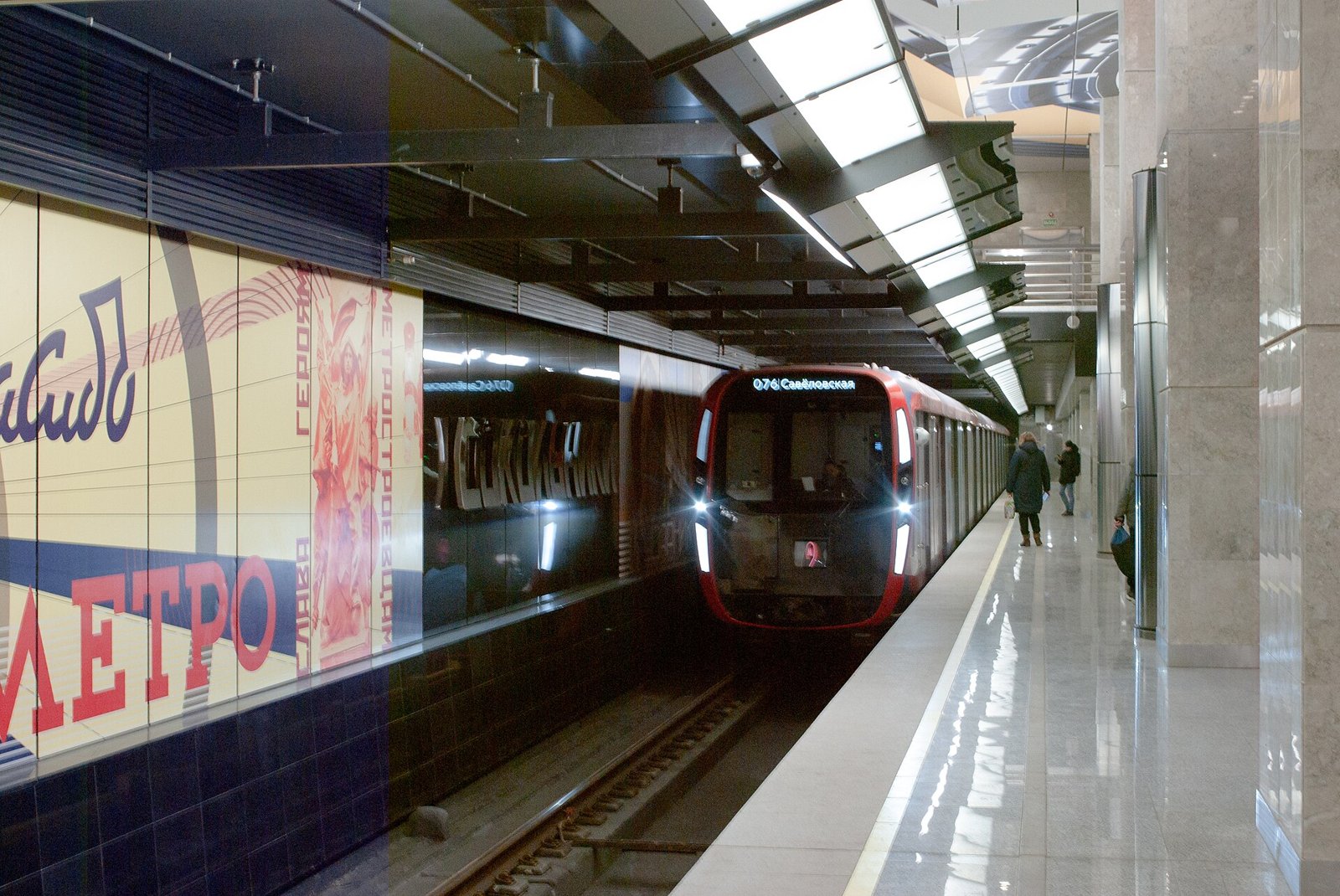 Sokolniki, Big Circle Line. Photo: Artyom Svetlov, Wikimedia Commons, CC BY 4.0

A simple self-guided route
One metro entry, roughly two to three hours depending on stops, no exits:
Ploshchad Revolyutsii → Arbatskaya → Kiyevskaya → (Circle Line) → Novoslobodskaya → Komsomolskaya → Taganskaya — transfer from blue line 3 to brown line 5 at Kiyevskaya and stay on line 5 through Novoslobodskaya, Komsomolskaya and Taganskaya. Mendeleyevskaya is a separate line-9 station, not a required stop. Mayakovskaya is an optional detour via Belorusskaya onto green line 2. Elektrozavodskaya and Park Pobedy lie in opposite directions on line 3: treat them as separate extensions, not successive stops.
Best time: Saturday or Sunday morning, before 11:00. On weekdays, avoid rush hours — the stations are beautiful, but not when you are pressed against a column.
Luggage and accessibility
Adult bicycles are prohibited unless folded; children’s bicycles are an exception. Check the operator’s current baggage rules before travelling.
Historic stations often involve long escalators, stairs and lengthy transfers. Do not assume that every entrance is step-free. Before travelling with a wheelchair, stroller or limited mobility, check the specific station and arrange assistance through the Metro Passenger Mobility Centre. Choose quieter hours with luggage and check current baggage rules before carrying oversized items.
Quick answers
Is the Moscow Metro safe? No transport system is risk-free. It is busy, well lit, full of staff and cameras. Watch your phone and wallet in crowds, as in any big city.
Can I use my foreign bank card? Foreign-issued Visa and Mastercard do not work at Moscow metro gates. Use cash to buy and top up a Troika.
Is there English? Yes. Signs and maps are in English, and announcements on many lines are in English too.
How long between trains? In the centre at peak time, often under two minutes.
Do I pay again when changing lines? No. Within the metro, you pay once on entry as long as you remain in the paid area. MCD commuter rail has separate validation and zone rules.
Photo credits are shown under each image. Images are from Wikimedia Commons under CC BY, CC BY-SA and archive licences; follow the links for full licence terms.
How did this land?
One tap. No account, no email, no cookie banner.
Comments (0)
Be the first to comment!